Zombie Ant Fungus: How Ophiocordyceps Really Works (2026 Update) | AntopiaUSA
The Zombie Ant Fungus Is Real — Here's How Ophiocordyceps Actually Turns an Ant Into a Puppet
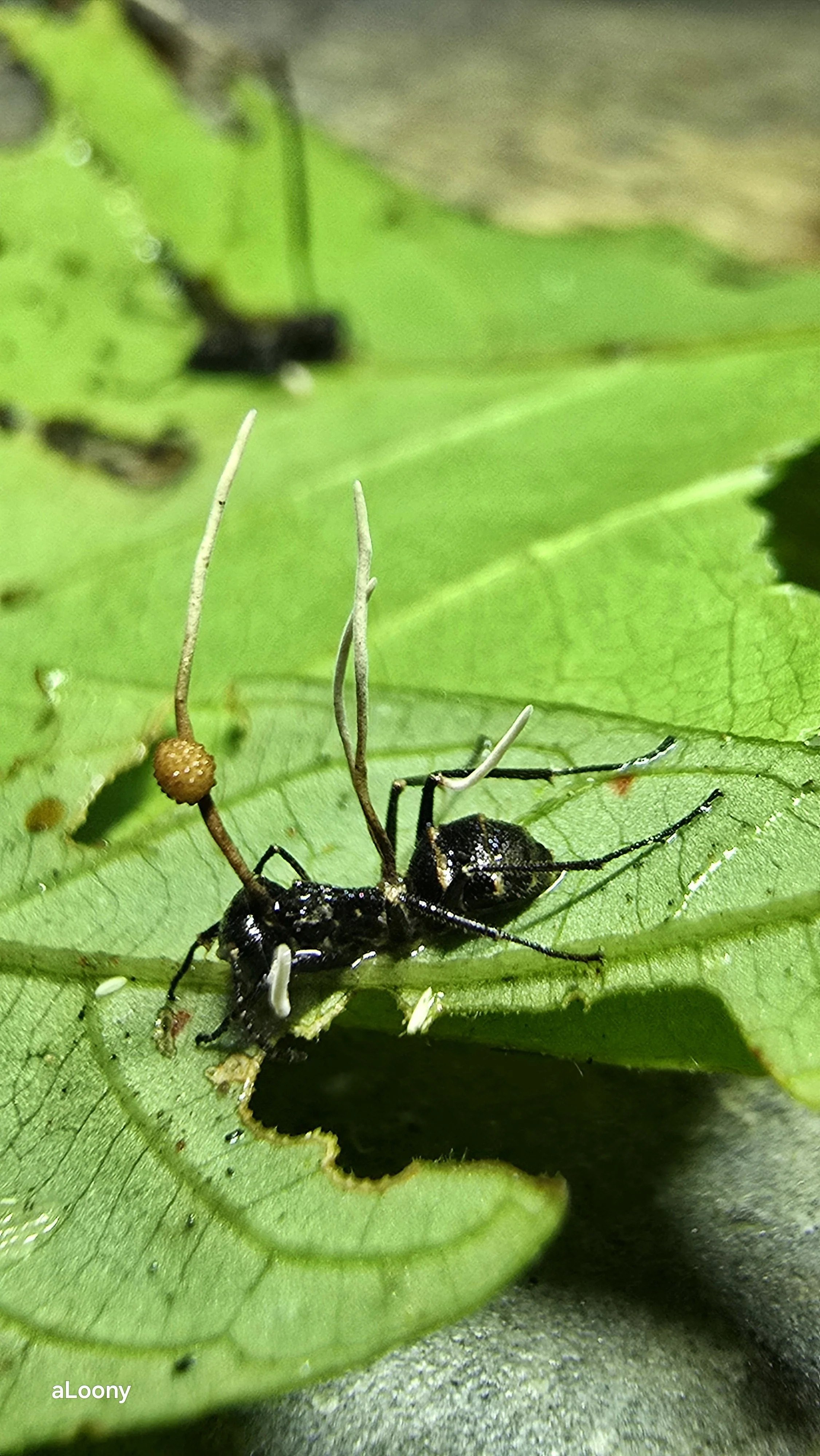
If you've watched The Last of Us, you already know the nightmare premise: a fungus that hollows out its host and drives it like a stolen car. What most people don't realize is that the writers didn't invent it. They borrowed it. Out in the world's rainforests, a fungus called Ophiocordyceps has been running this exact playbook on ants for at least 99 million years — long before there were humans around to be horrified by it.
At AntopiaUSA we spend our days keeping ants alive and thriving. So a fungus whose entire evolutionary purpose is the opposite — to take an ant apart from the inside — is equal parts fascinating and unsettling. And thanks to a wave of new research in 2025, we now understand this "zombie ant fungus" better than ever. Here's the real story, updated.
What Is the Zombie Ant Fungus?
The zombie ant fungus is the common name for a group of parasitic fungi in the genus Ophiocordyceps, most famously the Ophiocordyceps unilateralis species complex. "Complex" is the key word — this isn't one fungus but dozens of closely related species, each one often specialized to hijack a specific kind of ant.
The relationship is brutally one-sided. The fungus doesn't just feed on the ant. It takes control of the ant's behavior, forces it to travel to the perfect location for the fungus to reproduce, kills it there, and then erupts from the corpse to rain spores down on the ant's former nestmates. The ant is, in every meaningful sense, a puppet — alive, moving, but no longer in charge.
How the Zombie Ant Fungus Infects Its Host
It starts with a single spore. A foraging worker ant, going about its day on the forest floor, brushes against a fungal spore that has landed on the leaf litter. The spore attaches to the ant's exoskeleton, germinates, and uses enzymes and pressure to punch through the ant's armor and get inside.
Once in, the fungus does something surprisingly patient. Rather than immediately consuming its host, it spreads slowly as thread-like cells throughout the ant's body, feeding on non-vital tissues and, crucially, threading itself into the ant's muscles. For days — sometimes weeks — the ant may look almost normal to its colony, even as the invader quietly takes up residence.
Then the behavior changes.
The "Death Grip": The Moment the Ant Loses Control
An infected ant abandons its normal routine. It leaves the safety of the colony's foraging trails and begins to wander erratically, suffering convulsions that cause it to fall from the canopy toward the cooler, more humid understory — precisely the temperature and humidity zone where the fungus grows best.
Then comes the eeriest part. The ant climbs. It clamps onto a leaf or twig, usually on the north side of the plant, at a height and orientation almost perfectly tuned for spore dispersal. And it bites down with its mandibles in what researchers call the "death grip." The ant locks its jaws into a leaf vein and never lets go. Shortly after, it dies — anchored in place, exactly where the fungus needs it.
Here's a detail that reads like science fiction but is very much fact: this final bite is often synchronized. Across many infected ants, the death grip tends to happen around solar noon, as if the fungus is reading a clock. Scientists have found the transition from wandering to the death grip is abrupt and coordinated with the time of day — the fungus controls not just what the ant does, but when.
How Does the Fungus Control the Ant's Brain?
For years the assumption was simple: the fungus eats the brain and drives the body. The truth turns out to be far stranger and, honestly, more disturbing.
The fungus does not destroy the brain. In one of the most surprising findings in this field, researchers discovered that Ophiocordyceps grows throughout the ant's entire body — wrapping around the brain but seeming deliberately careful not to obliterate it. The central control system is left intact. The fungus wants the lights on.
So how does it steer? Instead of hitting the brain directly, the fungus invades the muscle tissue itself. Studies of the death grip found that the hypercontraction locking those mandibles shut is driven by fungal cells physically overgrowing and chemically interfering with the muscle fibers — not by destroying the nerves that would normally control them. In effect, the fungus bypasses the ant's brain and seizes the body's hardware directly, like cutting a puppet's strings and grabbing the limbs by hand.
On top of the mechanical takeover, there's a chemical assault. The fungus floods the ant with a cocktail of behavior-altering compounds and switches the ant's own genes on and off throughout the infection. Transcriptomic studies — which measure which genes are firing — found that during the manipulation phase, certain fungal genes for secreted proteins and secondary metabolites spike to between 5,900 and 12,000 times their normal levels. That is not background noise. That is a chemical arsenal being deployed at full throttle at the exact moment the ant loses control.
Perhaps the most elegant finding of all: the fungus releases its behavior-controlling chemicals only when it recognizes the brain of its natural target host — and not when it finds itself inside the wrong species of ant. It has evolved a molecular host-recognition system. It knows whose brain it's holding.
What's New in 2025 and 2026?
This is where the story gets fresh, because the science is moving fast.
The zombie ant fungus is far more diverse than anyone thought. In 2025, researchers described a wave of previously unknown species. Six new zombie-ant fungi were identified from western Mexico alone, with names like Ophiocordyceps camponoti-striati and O. jaliscana. A brand-new lineage was found in the graveyards of ant colonies in Minas Gerais, Brazil, and another new species, O. acanthoponerae, was described attacking a completely different ant host in a Brazilian rainforest ecotone.
It may not be as picky as we believed. For a long time the textbook line was that the O. unilateralis complex specializes almost exclusively on carpenter ants and their relatives (the Camponotini). But the 2025 Mexican study found two species of Cephalotes — turtle ants, from an entirely different subfamily — falling victim to the fungus. That challenges a core assumption and suggests the zombie ant fungus has jumped between more branches of the ant family tree than we credited it for.
This is an ancient arms race. A fossil described in recent research shows a fungus strikingly similar to modern Ophiocordyceps bursting from an insect trapped in amber 99 million years ago — spores erupting from a domelike structure on the host's back. Zombifying fungi were manipulating insects while dinosaurs were still walking around. This is not a new trick. It is one of the oldest and most refined forms of mind control on Earth.
Is the Zombie Ant Fungus Dangerous to Humans?
Short answer: no. And this is the part The Last of Us got deliberately wrong for drama.
Ophiocordyceps is exquisitely specialized. Its whole strategy depends on the specific biology of a specific insect host — the right muscle chemistry, the right nervous system, and critically, the right body temperature. Human body temperature alone is a formidable barrier; the vast majority of fungi simply cannot grow at 98.6°F. The fungus that can pilot a carpenter ant has no machinery for a mammal. There is no realistic path for it to "jump" to people. Enjoy the show, then sleep fine.
What This Means for Ant Keepers
Here's the practical bridge for anyone who keeps a colony. Wild ant populations are held partly in check by parasites like Ophiocordyceps — it's one of nature's ways of keeping any single colony from overrunning the forest. A healthy captive colony, kept in a clean enclosure and never exposed to wild fungal spores, simply doesn't face this threat.
That's actually one of the quiet joys of keeping ants indoors: you get a front-row seat to all the fascinating biology — the foraging, the brood care, the colony coordination — without the grim parasites of the wild. Good husbandry does the rest. Keeping your setup clean, offering fresh food, avoiding excess moisture that invites mold, and maintaining a proper heat gradient so your ants can regulate themselves all add up to a resilient, thriving colony.
If you want to watch ant behavior up close — the real kind, not the zombie kind — that's exactly what a well-built ant farm is for. Our come with everything a beginner needs to raise a healthy colony from the start, and our walk you through keeping it that way.
The Bottom Line
The zombie ant fungus is one of those rare cases where real biology outdoes anything a screenwriter could dream up. A patient, ancient, chemically sophisticated organism that pilots its host by the muscles, spares the brain on purpose, reads the position of the sun, and has been perfecting the routine since the age of dinosaurs — and in 2025, we learned it's more diverse and more adaptable than we ever realized.
Nature is stranger, and more brilliant, than fiction. We just prefer our ants very much alive and in charge of themselves.
Curious about keeping your own healthy colony? Browse our and start your ant-keeping journey with AntopiaUSA.
Sources: